Managing Slack in Linked Systems: When to Model It Away, When It Must Stay
Plain-Language Summary
Slack is the give in a linkage before it pushes: a loose grip, stretchy tissue, a muscle not yet switched on. Swing models usually leave it out. This page tests when that changes the answer. In a small synthetic model it depends on what you measure, which slack you assume, and how fast each channel responds. No golfer was measured.
Key Takeaways
- Leaving slack out is a model reduction; say which output it was checked against and with what tolerance.
- When both channels share the same linear dynamics, no output built from net torque can tell the two programs apart; when their lags differ, the programs separate even with no slack at all.
- A zero-transmission count is not a safe slack detector: a smooth stiffening spring never transmits exactly zero, yet at 12 mrad it favors persistent direction by 129% against the dead zone’s 172%, and by more than the dead zone below about 6 mrad.
- Which preparation looks best depends on the declared output; every management strategy is a trade, and none is shown here to help a golfer.
Tow a car with a rope and the rope goes slack whenever the cars drift together; the next pull arrives late, with a jerk. Does that slack change which way of driving looks better? It depends on what you score: arrival, smoothness, or each rope’s own effort. Couplings in machines have the same kind of give. Your hands on a club may have it too; whether they do has not been measured. Engineers call this give slack. Most golf-swing models leave it out, which is fine when the answer you care about does not depend on it. This page sets up a small test that shows when the answer does depend on it, and what the usual ways of managing slack cost. It is a test of models, not of golfers.
This is a draft for panel review and must not be published before the gate on issue #5135 is cleared. It covers modeling and management choices only. The feel of a firm lead wrist, impact and the “heavy hit” belong to #5134. Whether the order in which slack takes up can reveal where torque comes from belongs to #5136.
The issue’s blockers are scoped out rather than resolved. Three High critiques remain open: Qualifying Rigid Constraints, Input-Dependent Boundary Conditions and Null Space Forces and Closed-Chain Indeterminacy. The UpstreamDrift null-space program is marked “publication blocked”. Its grip-preload and co-contraction validations (VAR-04 and VAR-05) are deferred for lack of an instrumented grip. Nothing below depends on those items, and nothing below resolves them.
1 Ignoring Slack Is a Modeling Choice
Every model of a swing has to decide how the hands meet the club. A model that leaves slack out makes the simplest choice: it welds the hands to the club and the forearm to the hand. That is an idealization, and the repository’s own guidance is to “document what was eliminated and why the reduced model remains adequate for the timescale of interest” (Sources of Nonlinearity). The choice is not innocent, either. Change only how the two hands are joined to the club, and you change the number of undetermined internal force directions (the allocation nullity): the number of independent ways the two hands can push against each other without the club noticing. It goes from 6 (weld) to 5 (shaft-twist revolute, a hinge about the shaft) to 3 (trail-hand ball joint, free to swivel). As the UpstreamDrift report puts it, “None of this says which grip a golfer uses” (closure alternatives report).
So when is it safe to leave slack out? This page proposes a working rule, to be tested rather than assumed: slack may be idealized away only when each declared output stays within a stated tolerance across the plausible slack representations. The rest of the page applies the rule to a small task and reports where it says “model it” and where it says “ignore it”.
2 Five Meanings of Slack, and the Models We Compare
“Slack” can mean a grip gap, series-elastic extension, low tangent stiffness, activation lag or low activation, and these “are not interchangeable” (Proximal-Distal Energy Transfer). Each is a different physical thing, and each has its own mathematical description. Table 1 lists the standard ones. Every one adds parameters, and every added parameter must either be measured or be shown not to matter.
| Representation | What it says | Memory? | Parameters it adds | Identification cost |
|---|---|---|---|---|
| No slack (stiff spring) | A stiff spring with no gap: it transmits from the first instant | No | None beyond stiffness and lag | None, but it hides the question |
| Dead zone | Nothing passes until the input exceeds a gap \(\delta\) | No | Gap \(\delta\) | \(\delta\) is invisible while the channel stays loaded one way |
| Play | The output keeps its last contact position until the input pushes the other face | Yes | Half-gap \(\Delta\), initial contact side | Needs reversals; the history must be known |
| Smooth stiffening spring | Soft near zero, stiffer under load | No | Softening length, stiffness | Trades off against stiffness |
| Series elasticity with activation | A spring in series with a force that builds up after a lag. Tested here only as a second linear lag, identical in both channels; a muscle also switches on faster than it switches off | Yes (internal states) | Stiffness, activation and force time constants | Lags trade off against each other |
| Hysteresis and friction | Loading and unloading follow different paths | Yes | Loop shape, friction coefficient | Excitation-dependent |
| Unilateral contact | A contact pushes but cannot pull, and may open | Yes (contact mode) | Contact stiffness or complementarity law, friction | Opening events must be observed |
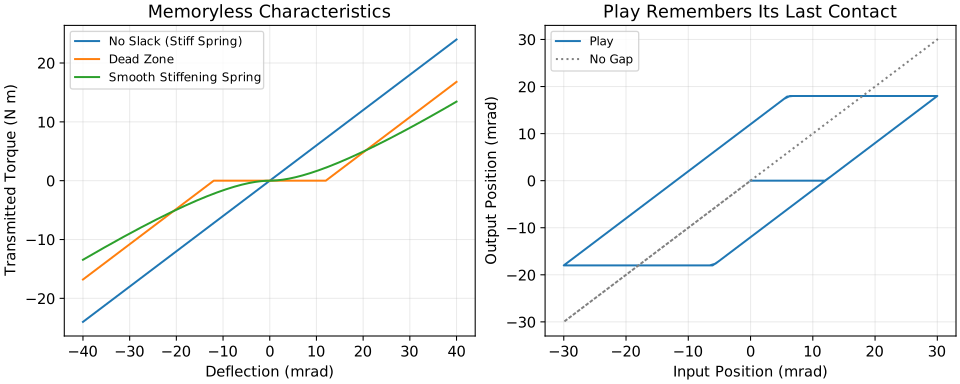
The second and third rows are easy to confuse, and the difference between them is memory. A dead zone is a memoryless map: the output depends only on the current input. A play operator remembers which face it last touched (Brokate and Sprekels 1996; Nordin and Gutman 2002). Think of a loose gear pair. Turn the input one way, then turn it back, and nothing moves until you have crossed the gap. So the same input position can leave the output in two places, depending on which way you came. Figure 1 shows both: on the left, torque against deflection for the memoryless laws; on the right, a play operator driven through two cycles, whose output at the same input depends on which face was last touched.
One archived repository result needs this caveat stated plainly. In the UpstreamDrift typed-slack audit, the class named transmission_backlash “is represented by the existing memoryless dead-zone-plus-damping surrogate; a stateful rate-independent play operator is not represented” (typed-slack study, limitations). Results under that class name are therefore dead-zone results.
Long description for all four figures on this page
The four figures compare two-channel torque transmission across representations, gap sizes, and preparation shifts. The representation-ladder diagram contrasts static memoryless torque-deflection laws against the hysteresis loop of a rate-independent play operator. The five-panel time-series figure plots net transmitted torque for persistent-direction and role-reversal programs under no-slack, dead-zone, smooth-spring, second-linear-lag, and unequal-lag models. The flip-map figure traces relative tracking-error advantage and zero-transmission duration across gap widths from 0 to 30 milliradians. The preparation-split chart sweeps internal torque shift from 0 to 24 newton metres across net error, per-channel error, peak overshoot, and preparation torque norm.The test below keeps the load fixed in place, so a play element and a dead zone centred on the load act the same way. Telling them apart needs a moving load, which is not tested here. Hysteresis, friction and unilateral contact in the full complementarity sense (Brogliato 2016) are also not run on this page.
3 The Test Task
The task comes from the published arm-wrist preload study (arm–wrist torque allocation and transmission preload), the same study the companion article on the firm lead wrist reads as a golf hypothesis. Two abstract torque channels, called arm and wrist, push on the same load. Their sum is the net torque. It must step from 6 N m before the switch to 10 N m after it. The switch is just the instant at which the requested torques change, time zero in the model. It is not the golfer’s transition from backswing to downswing, and the model ties it to no moment in a swing. Two programs reach the same net targets in different ways:
- Persistent direction. The arm goes from \(+10\) to \(+16\) N m and the wrist from \(-4\) to \(-6\) N m. Neither channel changes sign.
- Role reversal. The arm goes from \(-4\) to \(+16\) N m and the wrist from \(+10\) to \(-6\) N m. Both channels change sign.
Each channel works like a spring that is told how far to stretch. It turns a desired torque \(\tau^*\) into a target deflection \(x^*\) (how far its spring must stretch). The deflection \(x\) relaxes toward the target with time constant \(T\), \(\dot x=(x^*-x)/T\). In words: the further the spring is from where it should be, the faster it moves, so it closes most of the distance within a few multiples of \(T\). The channel then transmits a torque \(\tau(x)\) set by its representation. The representation is the rule that turns stretch into torque, and it is where the slack lives. The published law uses a dead zone \(\delta=0.012\) rad, stiffness \(k=600\) N m rad\(^{-1}\) and \(T=18\) ms, all “synthetic sensitivity parameters, not identified tissue or grip properties.” Starting from the loaded state before the switch, we report four outputs:
- Integrated tracking error \(J\) (net): the area between desired and transmitted net torque, \(J=\int|\tau^*_\Sigma-\tau_\Sigma|\,dt\), in N m s. Smaller is better. Shortfall and overshoot both add to it, so it is not an angular impulse, although the published study and the data file call it an “error impulse”.
- Per-channel tracking error \(J_\text{ch}\): the same area summed over each channel’s own target.
- Zero-transmission time: how long a channel transmits exactly zero torque.
- Peak overshoot: the largest excess of transmitted over desired net torque.
For scale, \(J\) is roughly the size of the step times the time constant: the 4 N m net step gives 4 N m × 0.018 s ≈ 0.072 N m s, and the channels’ 8 N m of total movement gives 0.144 N m s; reversal’s 36 N m of total movement gives about 36 × 0.018 ≈ 0.648, close to the 0.646 in Table 2. With no slack the exact value is 4 N m × 18 ms = 0.0720 N m s; the 0.1 ms time step accounts for the last 0.0002.
The advantage \(A\), relative to persistent, is \(A=(J_\text{reversal}-J_\text{persistent})/J_\text{persistent}\). A positive \(A\) favours persistent direction. An advantage of 100% would mean reversal makes twice the error.
Before trusting any new result, the code committed with this page reruns the published case on its 0.12 s window. It reproduces the published errors of 0.0717 N m s (persistent) and 0.1954 N m s (reversal), to within \(10^{-16}\) N m s, and the 11.5 ms and 22.0 ms zero-transmission intervals exactly on the 0.1 ms step (the \(10^{-16}\) tolerance applies to the errors, not the intervals). It also recovers the published grid verdict: of 12 dead-zone and time-constant cells, 9 favour persistent direction and 3 (all with zero dead zone) are equivalent. The new runs below use a 0.5 s window so that slower channels are not cut off. That longer window is why the dead-zone row below reads 0.0718 and 0.1955 rather than 0.0717 and 0.1954.
4 What Each Representation Says
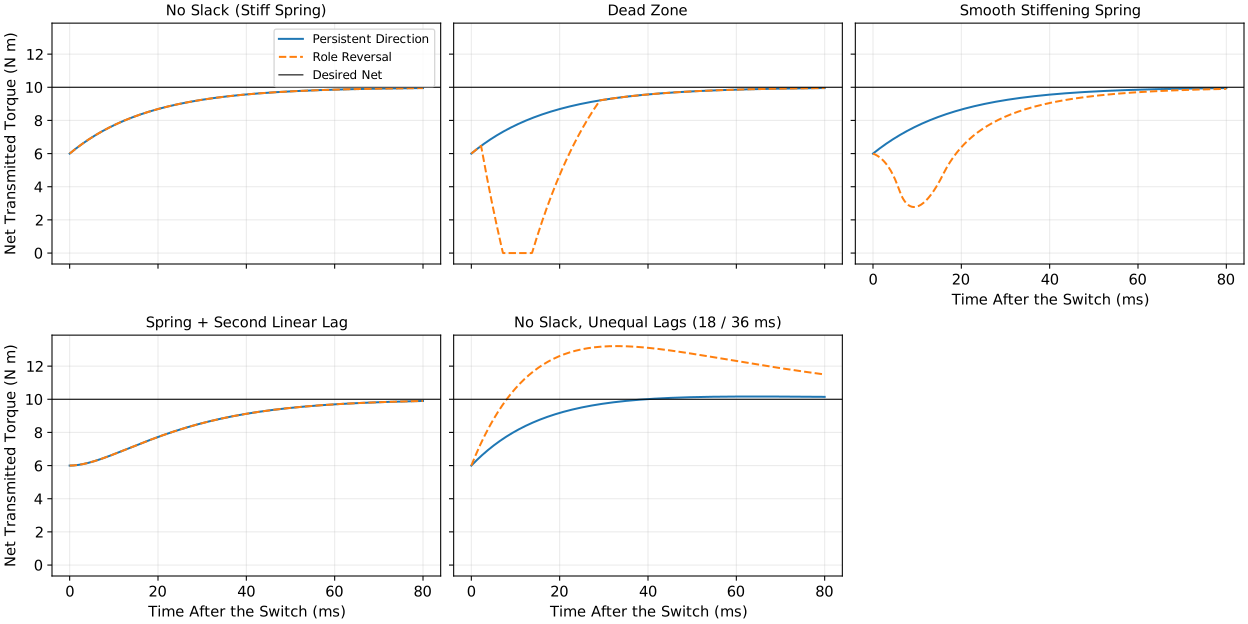
Table 2 and Figure 2 run both programs through five representations; in the figure the black line is the desired 10 N m. The no-slack row is not rigid: it keeps the 600 N m rad\(^{-1}\) spring and the 18 ms lag and removes only the gap. The unequal-lag row gives the arm an 18 ms lag and the wrist a 36 ms lag, with no slack at all. Where to look first: the Advantage \(A\) column, which says how much more error role reversal makes than persistent direction. The two columns before it are the scores behind \(A\). The three after it are other outputs a modeller might have declared instead, and the four lessons below say where they disagree with \(A\).
| Representation | Net \(J\), persistent (N m s) | Net \(J\), reversal (N m s) | Advantage \(A\) | Longest zero transmission | Per-channel \(J_\text{ch}\), persistent / reversal (N m s) | Reversal overshoot (N m) |
|---|---|---|---|---|---|---|
| No slack (stiff spring) | 0.0718 | 0.0718 | 0% | 0 ms | 0.144 / 0.646 | 0 |
| Dead zone | 0.0718 | 0.1955 | 172% | 22.0 ms | 0.144 / 0.827 | 0 |
| Smooth stiffening spring | 0.0730 | 0.1674 | 129% | 0 ms | 0.147 / 0.741 | 0 |
| Spring + second linear lag (10 ms) | 0.1114 | 0.1114 | 0% | 0 ms | 0.223 / 1.003 | 0 |
| No slack, unequal lags | 0.0599 | 0.2449 | 309% | 0 ms | 0.180 / 0.934 | 3.21 |
Four lessons come out of this table.
Shared linear channels cannot tell the programs apart by net torque. Here is why. When both channels obey the same linear dynamics, each channel moves from its old target to its new one along the same-shaped curve. So the net torque moves from the old net to the new net along that same curve too. That is superposition: the net response depends only on the net targets, and both programs share those. The no-slack and second-linear-lag rows are therefore equal to rounding, whatever the time constants. The second-linear-lag row adds an identical 10 ms linear lag ahead of each channel’s deflection lag. It has no muscle, no on/off asymmetry and no opposing pair, so its 0% holds by construction and is not evidence about muscles; the nonlinear muscle model, which does not give 0%, is compared in #5134. The published “equivalent at zero dead zone” verdict is this identity.
Unequal lags separate the programs without any slack. That identity needs both channels to respond at the same speed. Give the arm an 18 ms lag and the wrist a 36 ms lag, and the difference between the programs’ net torques is \(14\,(e^{-t/18\text{ ms}}-e^{-t/36\text{ ms}})\) N m. Read the formula as two head starts fading at different rates. The programs begin with the arm channels 14 N m apart and the wrist channels 14 N m apart the other way. The arm difference fades on an 18 ms clock and the wrist difference on a 36 ms clock, so for a while they no longer cancel. The difference is largest at \(t=36\ln 2\approx 24.95\) ms (the fast difference has fallen to a quarter while the slow one is still at half), where it equals \(-3.50\) N m (persistent minus reversal; reversal runs ahead and overshoots), 35% of the 10 N m target. The simulation gives \(-3.51\) N m at 24.9 ms. This counterexample came from Argon’s independent check (AffineDrift PR #5140). A difference between the two programs is therefore not, by itself, evidence of slack. The speed difference meant here is a channel lag mismatch: one channel responds more slowly than the other. In this linear model it favours persistent direction whichever channel is slower; swapping the two lags still gives an advantage of 140%. A different kind of speed difference, muscles switching on faster than they switch off, can favour reversal; that is the companion article’s muscle result.
A gap detector can miss slack that matters. The smooth stiffening spring never transmits exactly zero, so a zero-transmission count reports “no slack problem”. Yet at a 12 mrad softening length its persistent advantage is 129%, against 172% for a 12 mrad dead zone, and below about 6 mrad the smooth spring’s advantage is the larger of the two (Figure 3). A softening length and a gap width are different quantities, so equal milliradian values are not equal amounts of slack; the comparison shows only that both change the answer by far more than any declared margin. Whether slack is negligible depends on the output that was declared, not on whether a gap is visible.
The no-slack model is not neutral on per-channel outputs. Even with no slack, role reversal has a larger per-channel error \(J_\text{ch}\) (0.646 against 0.144 N m s), simply because each channel has further to travel: going from \(-4\) to \(+16\) N m is a longer trip than going from \(+10\) to \(+16\). Idealizing slack away is safe for one output and not automatically for another.
5 How Big Must a Gap Be to Matter?
Now the practical question: how small must a gap be before we may ignore it? Figure 3 sweeps the gap (or the softening length) from 0 to 30 mrad. To apply the working rule, pick an equivalence margin: the largest advantage you are willing to call “no difference”. The margin is a declared choice, not a fact about golf, so three are shown as dotted lines (1%, 5% and 10%); the inset magnifies the first 0.6 mrad, where all three are crossed. The right panel shows the longest zero-transmission interval of the role-reversal program for three lags.
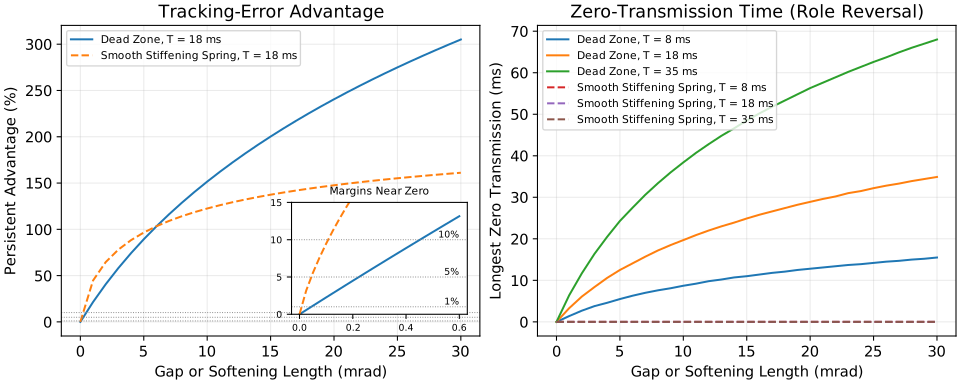
For the dead zone, the advantage passes 1% at a gap of 0.044 mrad, 5% at 0.22 mrad and 10% at 0.45 mrad. For the smooth spring the same margins are crossed at 0.0063, 0.044 and 0.11 mrad. Those are very small gaps. For scale, the 6 N m wrist target stretches a 600 N m rad\(^{-1}\) spring by 10 mrad. Under a 5% margin, then, a gap of about 2% of that stretch is already enough to require explicit modeling. At the declared 12 mrad, the advantage is 172% (dead zone) and 129% (smooth spring).
Two further results bear on the decision rule:
- The advantage barely depends on the lag; the gap time does. At 12 mrad the dead-zone advantage is 172% for lags of 8, 18 and 35 ms. The zero-transmission interval, by contrast, is 9.8, 22.0 and 42.8 ms. When both channels share one lag, a slower lag plays the same film in slow motion. Every time stretches in proportion to the lag, so the dead time grows with it. Both error areas stretch by the same factor, so their ratio stays put, on a window that holds the whole response. The absolute difference between the programs, by contrast, grows roughly in proportion to the lag. That is what the companion article’s robustness figure plots, on the shorter 0.12 s window: at 12 mrad the difference is 0.0548, 0.1237 and 0.2408 N m s for lags of 8, 18 and 35 ms, and \(0.0548\times35/8\approx0.240\). That window cuts off part of the slowest response, so the ratio there drifts from 172.3% and 172.5% to 178.0% at 35 ms. A conclusion stated in milliseconds of “dead time” is therefore much more sensitive to an unmeasured lag than one stated as a ratio of tracking errors.
- A richer model passes the rule for one target and fails it for another. The published reduced muscle model, with activation and series-force dynamics, gives 0.08998 N m s for persistent direction against 0.09084 N m s for role reversal at its 0.2 ms step over its 0.12 s delivery window (Proximal-Distal Energy Transfer), an advantage \(A\) of about 0.95%, inside all three margins. That is not a robust equivalence. The #5134 draft’s muscle-model results (What the Two Models Say, in PR #5143) show the difference shrinking to about 0.4% once the integration step is converged. For a 14 N m delivery target, on the same 0.12 s window, role reversal scores 0.1505 against 0.1918 N m s for persistent direction, an advantage of about \(-22\%\). That case leaves every margin, so under this page’s rule the muscle model also requires its representation to be declared.
6 Managing Slack: Strategies and Costs
Engineers manage slack in machines in several ways (Nordin and Gutman 2002). They preload a drive so it never crosses its gap. They invert a known dead zone in the controller, which can be done adaptively when the gap is unknown (Tao and Kokotović 1994). Or they deliberately add a series spring. That accepts a lower force bandwidth in exchange for shock tolerance, more accurate force control and energy storage (Pratt and Williamson 1995). Biology offers close analogues. Series compliance can slow the rate of force rise (Mayfield et al. 2016). Short-range muscle stiffness gives an immediate response to perturbation (De Groote et al. 2017). Co-contraction can buy robustness under uncertainty at an energetic cost (Berret et al. 2024). These are analogies only; none of them shows what a golfer’s hands do.
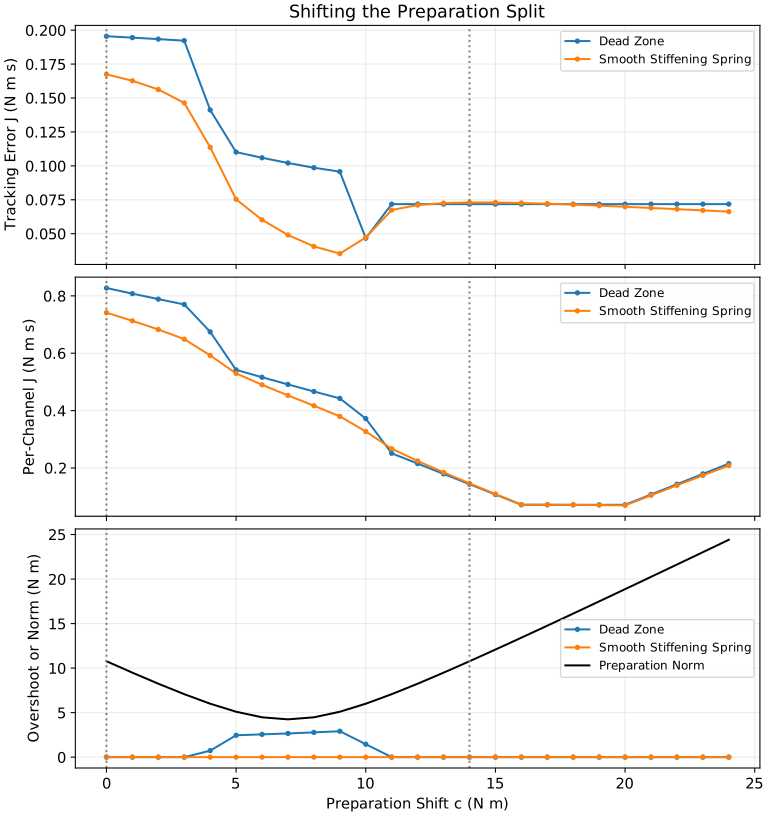
The two-channel task lets us try preload and its relatives on a single dial. Every preparation with the same 6 N m net can be written as role reversal plus a preparation shift \(c\), a squeeze added before the switch: add \(c\) to the arm and subtract it from the wrist. The net is unchanged. At \(c=0\) the dial gives role reversal, and at \(c=14\) N m it gives persistent direction. This is the same kind of load as squeezing a box: it cancels on the club. Here, though, \(c\) is measured from the role-reversal preparation, so it is not the total internal load. Figure 4 sweeps \(c\) from 0 to 24 N m; dotted lines mark the two published programs.
In plain terms, \(c\) is how hard you squeeze the club between your hands before the switch, counted from the role-reversal start; the box doesn’t move however hard you squeeze. The one-line result: lowest net error comes from unloading the wrist that must flip; lowest per-hand error comes from pre-loading both in their delivery direction; neither is shown to help a golfer.
Which setting of the dial is best? It depends on what you are minimising:
- \(J\) rewards unloading the channel that must reverse. On the 1 N m grid, the dead zone’s lowest \(J\) comes from the preparation that leaves the wrist torque at zero, the centre of its gap: \(c=10\) (0.0467 N m s). The smooth spring has no gap; it does best one step earlier, at \(c=9\) (0.0353 N m s), with 1 N m still on the wrist in its pre-switch direction. Both beat persistent direction (0.0718 and 0.0730 N m s). The dead-zone value is a single grid point that its neighbours do not support: \(c=9\) gives 0.0957 N m s and \(c=11\) gives 0.0718 N m s. It is a knife-edge, not a robust optimum. Under the dead zone that preparation also overshoots the target by 1.45 N m, because the wrist’s opposing torque arrives late.
- \(J_\text{ch}\) rewards preloading each channel in its delivery direction. For the dead zone \(J_\text{ch}\) is lowest, at 0.0718 N m s, for every \(c\) from 16 to 20 N m. For the smooth spring it is lowest at \(c=20\) (0.0698 N m s). Beyond that, more internal load only adds error.
- Internal load is not free. The preparation torque norm \(\sqrt{\tau_\text{arm}^2+\tau_\text{wrist}^2}\), a rough measure of how much torque the preparation asks of both channels together, is 10.77 N m for both extremes (\(c=0\) and \(c=14\)). It falls to 4.24 N m at \(c=7\) and rises to 18.87 N m at \(c=20\). Under the dead zone, \(J\) is 0.0718 N m s for every \(c\) from 11 to 24 N m: once both channels are loaded in their delivery direction, more internal load buys nothing. A Euclidean torque norm is not metabolic effort.
Table 3 collects the strategies. “Not established” means the repository record contains no evidence either way.
| Strategy | What it does in the model | Modeled benefit | Modeled cost | Speed, face control, injury |
|---|---|---|---|---|
| Preload (persistent direction) | Keeps each channel loaded the way it will deliver | No zero-transmission gap; lowest \(J_\text{ch}\) | Larger preparation torque than the minimum-norm split | Not established |
| Extra opposing torque | Adds internal load beyond sign consistency, with stiffness and gap held fixed (so not the stiffening of real co-contraction) | Smooth spring: slightly lower error | Torque norm grows; dead zone: no further gain | Not established |
| Exploit compliance | Accepts a spring in series | Shock tolerance and energy storage (engineering analogy) | Slower force rise | Not established |
| Early take-up by timing | Starts the reversal before the switch | Hides the recovery time (under the dead zone the reversing wrist takes 31.1 ms to reach 10% of its target with the right sign) | Requires an earlier, accurately timed command | Not established |
| Deliberate role reversal | Separates preparation and delivery roles | Lowest \(J\) on the grid, at a single knife-edge split (\(c=10\) under the dead zone), not a robust optimum | Gap, overshoot or both, depending on representation | Not established |
7 One Output Channel Cannot Name the Slack
The working rule asks which representation is plausible. Can data answer that? From a single output, perhaps not. In the UpstreamDrift audit of five slack classes under a multisine reversal, every local three-parameter sensitivity matrix is full rank. Yet the contact-disengagement and biological-series-compliance classes differ by only 1.96% in normalized output RMSE (typed-slack study). Full rank means parameters can be estimated if the class is already known. It does not mean one class can be told from another. If you know the recipe, you can taste how much salt went in; tasting alone may not tell you which recipe it was, and here two different recipes taste within 2% of each other. The same record’s H10 entry adds that “preload matching reverses open/taut classification” (falsification matrix).
The distributed-grip evidence needs a counting caveat. In plain words: one counter in that study reads zero, but it counts only changes between “some contact point touching” and “every point open”. Other probes in the same study see single points opening and reattaching many times. A zero on that counter does not mean no contact point opened. At the pinned commit, the distributed-grip atlas reports maximum_transition_count = 0 alongside maximum_open_fraction = 1.0. The atlas’s separate event probes register 80 openings and 186 reattachments. The atlas version that Proximal-Distal Energy Transfer describes (288 trajectories) has no friction. The pinned version (576 trajectories) adds Coulomb coefficients of 0 and 0.35, which the atlas labels “equipment-provisional bounds”, with the true coefficient “not_identified”. Whether take-up order could separate the classes is the subject of #5136 and is not argued here.
8 A Decision Rule and Its Falsifiers
Put together, the working rule becomes a procedure:
- Declare the outputs (for example \(J\), \(J_\text{ch}\), event timing, overshoot) and an equivalence margin for each.
- Run each output across at least a no-slack model, a gap model, a smooth model and a model with unequal channel lags, over a plausible range of gap sizes.
- If every output stays within its margin, the no-slack model is adequate for those outputs. If any output leaves its margin, represent the slack and report which representation was assumed.
The rule would show the no-slack idealization to be adequate if measured bilateral loads showed no sign reversals in the window of interest, and the declared outputs stayed within their margins across representations fitted to those loads. It would make representation mandatory if conclusions flipped between fitted representations. A third outcome, that conclusions flip but no measurement can say which representation holds, is the identifiability problem of #5136.
9 Measurements That Would Settle It
The preload chapter lists the measurements (measurements that can refute the interpretation). They are bilateral six-axis grip wrenches with pressure distribution, perturbation-based estimates of tangent stiffness, and surface EMG read as activation timing rather than torque. Instrumented clubs that measure internal grip force exist (Choi and Park 2020). The UpstreamDrift record notes that each grip model “is a declared alternative and none is validated” (closure alternatives report). This page adds one requirement: measure each channel’s response time separately, because unequal lags mimic slack.
10 What This Article Does Not Establish
Every number above comes from a synthetic task with invented parameters. The page does not show that a golfer’s hands, wrists or forearms contain a gap, or how large one would be. It does not show that any management strategy changes club speed, face control, dispersion, injury risk or feel. The isometric task cannot separate play from a dead zone, and hysteresis, friction and full complementarity contact were not run.
- TODO(source): measured magnitudes of human grip, wrist or forearm slack (gap size, tangent stiffness near zero load, per-channel lag). None is cited here. An earlier unsourced dead-zone duration was removed upstream (citation verification table) and is deliberately not reused.
- TODO(source): any measured effect of grip preload or co-contraction on club or ball outcomes (UpstreamDrift VAR-04 and VAR-05, deferred).
- TODO(source): research-scout confirmation of the engineering summaries attributed to Nordin and Gutman (2002), Tao and Kokotović (1994) and Pratt and Williamson (1995) against the full texts. The DOIs and abstracts were checked; the full texts were not.
Reproducing the Numbers
Apart from the muscle-model values cited from other articles and the companion’s 0.12 s dead-zone values in Section 5, which are not in results.json and are recomputed by tests/test_slack_management_article.py, every number in Section 3 to Section 6 is read from data/slack_management/results.json, and every figure is drawn from it. Both are regenerated by:
python3 -m scripts.build_slack_management_dataThe model is in src/tools/slack_transmission.py and the studies in src/tools/slack_management_studies.py. tests/test_slack_transmission.py checks the reproduction of the published study, the linear-superposition identity, the unequal-lag counterexample and that the committed data match a fresh build. tests/test_slack_management_article.py checks that each number quoted on this page matches the data file.
11 Revision History
2026-10-24: Drafted the article on modeling and managing slack in linked systems for panel review (#5135).
References
Citation
@online{olson2026,
  author = {Olson, Dieter},
  title = {Managing {Slack} in {Linked} {Systems:} {When} to {Model}
    {It} {Away,} {When} {It} {Must} {Stay}},
  date = {2026-10-27},
  url = {https://affinedrift.com/articles/slack-management-linked-systems.html},
  langid = {en},
  abstract = {Leaving out grip gaps, tissue compliance and activation
    lag is a model reduction that must be declared. Using a two-channel
    transmission task that reproduces a published UpstreamDrift study to
    within 10\^{}-16 N m s, we compare no-slack (stiff spring),
    dead-zone, smooth-stiffening, second-linear-lag and unequal-lag
    representations. Shared linear channels cannot distinguish a
    persistent-direction program from a role-reversal program; unequal
    lags distinguish them without any slack; a smooth spring with no
    zero-transmission interval still favors persistent direction by
    129\% at a 12 mrad softening length (the role-reversal program makes
    129\% more error than the persistent-direction program). A gap of
    0.22 mrad, about 2\% of the 10 mrad stretch produced by the final 6
    N m wrist torque, already exceeds a 5\% equivalence margin. The best
    preparation depends on the declared output: the integrated tracking
    error of the net torque rewards unloading the channel that must
    reverse, while per-channel error rewards preloading each channel in
    its delivery direction. All parameters are synthetic.}
}